If you have ever stood in a layby with a warm brew, watching the motorway traffic roll past, you know the exact sound I am talking about. It’s that deep, low-frequency rumble that rattles through your chest long before you actually see the Griffin badge cresting the hill. Scania didn’t just accidentally become haulage royalty—they spent the last seventy-plus years earning every single bit of that reputation, one long climb at a time.
It Started with Cold Winters and Big Snouts
Cast your mind back to the early 1950s. The world was slowly getting back on its feet, European freight was expanding, and over in Sweden, Scania-Vabis was building heavy-duty kit designed to survive sub-zero logging routes.
Back then, lorries looked like proper lorries—huge, long bonnets sticking out front like giant iron noses. The L51 and L71 Regent were absolute workhorses, but Scania’s engineers were restless. They noticed that standard diesel engines were choking a bit when asked to drag heavy timber up frozen mountains.
So, in 1951, they decided to bolt a turbocharger onto a commercial truck engine—a massive deal at the time. By 1954, the turbocharged 10-litre DS10 was born. It proved you didn’t need a larger, heavier engine block to get more power; you just needed to force-feed it more air.
Moving the Cab and Dropping the V8 Bomb
As the 1960s rolled around, European road laws started getting strict about overall vehicle lengths. Having a massive bonnet out front meant you were losing precious cargo space on your trailer. The solution? Put the driver right on top of the engine.
The cab-over era was born, bringing us vehicles like the LB110 with a cab that actually tilted forward so mechanics didn’t have to double as contortionists just to drop the oil.
Then came 1969, the year that changed long-distance transport forever.
Scania quietly dropped a massive bombshell onto the transport world: the 14-litre DS14 V8. At a time when most drivers were chugging along with 200 or 250 hp—gear-crunching their way up hills while keeping an eye on the temp gauge—Scania rolled out an engine pushing a staggering 350 hp.
It didn’t just climb hills; it flattened them. That legendary V8 rumble was born, and overnight, international tramping had a new hero. If you were pulling heavy loads across continents, that was the truck you wanted your name on.
The Golden Era of Pure Mechanical Grit
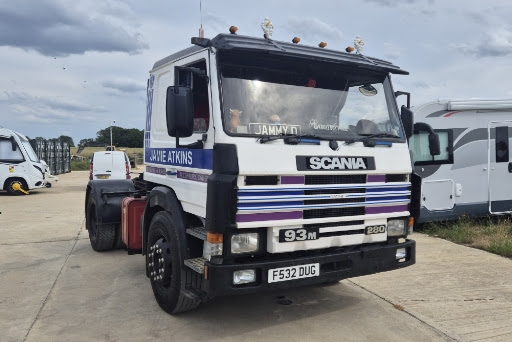
By the 1980s, Scania hit absolute gold. They figured out that instead of building completely different lorries for different jobs, they could build them like Lego sets—a modular system where you could mix and match cabs (G, P, R, and T) and chassis to get the exact tool for the job.
This era gave us the 2-Series and the iconic 3-Series, vehicles that many driver-owners still swear were the absolute peak of commercial vehicle design. The 143 V8 became an instant legend—a simple, bulletproof, mechanically-driven beast that would happily rack up millions of kilometers with basic servicing, looking cool as ice while doing it.
When they smoothed out the lines in 1991 to create the aerodynamic Streamline, they proved you could have brutal power and still save fuel at the pumps.
Digital Brains and Ultimate Muscle
As we slipped into the 1990s and 2000s, computers started finding their way under the cab floor. Italian design house Bertone gave the 4-Series a smoother, rounder look, while Electronic Diesel Control (EDC) replaced traditional mechanical linkage.
By the time the PRT range and Highline/Topline cabs hit the roads in the mid-2000s, long-distance driving had transformed from a grueling physical workout into a high-tech job. Cab suspensions smoothed out the bumps, interior space expanded into miniature living rooms, and the V8 just kept growing—first to 16 litres, pushing past 500, 600, and eventually 700 horsepower.
Today, the Next Generation S-Series offers completely flat floors, digital dashboards, and autonomous safety features. The top-of-the-tree 770S pumps out an eye-watering 770 hp and 3,700 Nm of torque. Yet despite all the modern computer screens and electric motor assists, that core Swedish DNA remains intact.
The Takeaway: Scania’s story isn’t just a list of model numbers—it’s the story of a maker that always put raw pulling power and driver pride right at the top of the priority list.
Scania Through the Ages: Quick-Reference Specs
Here is the quick-glance breakdown showing how the tech and power escalated through the decades:
| Generation / Era | Highlight Engine / Spec | Key Breakthrough or Legacy |
|---|---|---|
| 1950s (Scania-Vabis) | DS10 (Turbocharged 10L Inline-6) | Pioneered turbocharged diesels for heavy haulage. |
| 1960s–70s (LB Series) | DS14 V8 (14L, 350 hp) | Introduced tilt-cabs and launched the iconic V8 engine. |
| 1980s (2 & 3-Series) | DSC14 V8 (Up to 470 hp in Streamline) | Modular chassis architecture and legendary mechanical durability. |
| 1990s–2000s (4-Series) | DC16 V8 (16L, 480–580 hp) | Bertone styling, electronic engine management (EDC), and Topline cabs. |
| 2010s–Present (Next Gen) | DC16 770 V8 (16.4L, 770 hp) | Flat-floor S-cabs, digital integration, and unmatched pulling torque. |
From the mechanical grit of 1950s bullnoses to the iconic roar of the 143 and today’s ultra-luxurious 770S, Scania built its legendary reputation by putting driver comfort and pure pulling power at the absolute center of everything they do.
Leave a Reply